
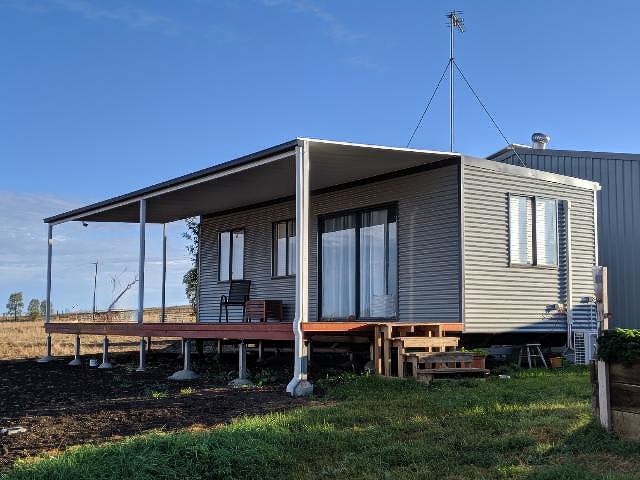
As a portable modular home developer in Queensland, I am often asked by homeowners how they can add extra living space without drowning in council paperwork. In the 2026 property market, the “20 SQM Rule” has become the golden threshold for those looking for a rapid, cost-effective expansion.
While larger secondary dwellings (often up to 80m²) are the trend for rental income, the 20m² category remains a unique regulatory “sweet spot.” It allows for the addition of hobby rooms or man-caves, home offices, or teenager retreats with significantly fewer hurdles than a full-sized house. However, there is a fine line between a “compliant studio” and an “illegal dwelling.” This article breaks down the technicalities of the 20 SQM rule specifically for the Queensland landscape.
1. What is the 20 SQM Rule?
In Queensland, the 20m² threshold generally refers to the size limit at which a “Class 10a” structure (a non-habitable building like a shed or studio) can often be built as accepted development, meaning it may not require a full planning or building permit, provided it meets specific siting requirements.
- The Habitable Distinction: The rule is often misunderstood. A 20m² structure used as a shed or tool room is vastly different from a 20m² habitable room (like a bedroom).
- The 2026 Standard: Under current 2026 regulations, even if a building is under 20m², if you intend for someone to sleep in it, it must meet National Construction Code (NCC) Class 1a standards for fire safety, waterproofing, and ceiling height.
2. Implementation: Why and When?
The focus on smaller, streamlined structures intensified in September 2022, when the Queensland Government removed the “related family” occupancy restriction.
- The “Why”: The government’s stated purpose was to improve rental housing supply across regional Queensland. By simplifying the rules for smaller structures, they encouraged homeowners to utilise unused backyard space for either family or the rental market.
- The Result: This shift turned the “20 SQM studio” from a simple hobby room into a potential “Micro-Granny Flat,” provided it is upgraded to meet habitable standards.
3. City Council Regulations and Fines
While state law removed occupancy restrictions, local councils still control the physical “envelope” of the building.
- Proximity Rules: In many councils, such as Brisbane and Logan, a secondary dwelling or studio must sit within 20 metres of the primary house to be considered “ancillary”.
- Setbacks: Even a small 20m² pod must respect boundary setbacks (typically 1.5m from side and rear boundaries).
- The “Fines” Factor: Using an unlicensed builder or failing to certify a habitable 20m² space as a “Class 1a” dwelling risks council-issued demolition orders or heavy fines, which can reach tens of thousands of dollars if the structure is deemed unsafe or non-compliant with fire separation codes.
4. Is this Australia-Wide or Only in QLD?
The “20 SQM” threshold is not a uniform Australia-wide law, though similar “exempt development” categories exist in other states with different limits.
- Queensland Specifics: QLD is unique in its recent aggressive move to allow anyone to rent these spaces out without a family connection.
- Comparison: In New South Wales, the cap for a secondary dwelling is typically 60m², but the lot itself must be at least 450m². In the Northern Territory, the limit was recently increased to 75m².
- The NCC Baseline: While planning rules vary by state, the Building Code (NCC) is the national standard that dictates the actual safety requirements for these structures.
Key Features of a Compliant 20m² Structure
| Feature | Specification | Why it Matters |
| Class 1a Rating | Habitable standard | Required if someone is sleeping in the unit. |
| Fire Separation | 1.8m from main house | Essential for safety and council compliance. |
| Smoke Alarms | Photoelectric (AS 3786-2014) | Mandatory state-wide by 2027. |
| Footings | Steel piers or screw piles | Allows for install on sloping QLD terrain. |
| Services | Shared water/power | Most 20m² units must “sub-meter” from the main house. |
This Class 10a vs. Class 1a Checklist is designed to help you understand the structural and legal “bridge” between a non-habitable studio and a compliant, rentable tiny home in Queensland.
The Compliance Bridge: Upgrading for Habitation
In Queensland, a Class 10a building is defined as a non-habitable structure (like a shed, carport, or private garage). To legally house a tenant or family member for sleeping, the structure must be certified as a Class 1a dwelling.
Class 10a vs. Class 1a Comparison Checklist
| Requirement | Class 10a (Studio/Shed) | Class 1a (Habitable Rental) | Upgrade Required? |
| Ceiling Height | No specific minimum. | Minimum 2.4m for habitable rooms. | Yes |
| Waterproofing | Basic weatherproofing. | Must meet AS 3740 for wet areas. | Yes |
| Energy Rating | None required. | Must achieve a 7-Star energy rating. | Yes |
| Fire Separation | General safety. | 60/60/60 FRL if within 900mm of boundary. | Yes |
| Smoke Alarms | Not mandatory. | Photoelectric & Interconnected. | Yes |
| Glazing | Standard glass. | Must meet AS 1288 for human impact. | Yes |
| Termite Protection | Recommended. | Mandatory barriers to AS 3660.1. | Yes |
Frequently Asked Questions (FAQ)
Q1: Can I build a 20m² granny flat myself?
Any building work valued over $3,300 must carry Home Warranty Insurance, and projects over $11,000 require an owner-builder permit from the QBCC. For habitable structures, professional certification is always required.
Q2: Does a 20m² pod need its own kitchen?
To be legally classed as a “self-contained” secondary dwelling, it must have a kitchen with a sink, a bathroom, and a laundry facility. In small units, a combined kitchen-laundry sink is often permissible.
Q3: Can I rent out a 20m² shed?
No. A shed is a Class 10a (non-habitable) structure. To rent it out, it must be certified as a Class 1a (habitable) dwelling, meeting all fire, sound, and energy efficiency standards.
Q4: Do I need a separate driveway for a small 20m² unit?
No. Most QLD councils (like Gold Coast and Brisbane) require the secondary dwelling to share the existing driveway and entry point with the main house.
Q5: What happens if I build without any approval?
You risk non-compliance fines, insurance problems (if a fire occurs, you may not be covered), and difficulty selling your home in the future, as the illegal structure will appear on building searches.