
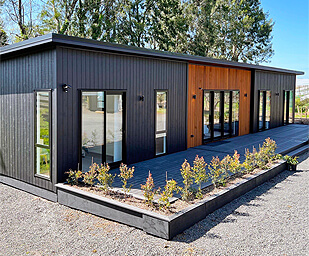
Queensland’s property landscape is experiencing a massive shift. Driven by a persistent housing shortage, a booming population, and the upcoming Brisbane 2032 Olympics runway, landowners are sitting on a goldmine, their own backyards. The era of relying on a single, traditional residential yield from a large block of land is fading. Savvy investors and homeowners are turning to multiple portable modular tiny houses to maximise their land’s earning potential.
As a portable modular manufacturer based right here in the Sunshine State, I work with clients daily who are transforming underutilised suburban blocks, semi-rural acreages, and tourism-zoned properties into high-yield micro-accommodation hubs. When executed correctly, leveraging your lot with multiple tiny houses can generate a reliable secondary income that outpaces standard long-term rentals, all while building long-term property equity.
Here is your comprehensive developer’s guide to turning your Queensland lot into a multi-unit modular income stream.
1. The Financial Blueprint: Earning Potential and Income Opportunities
The primary reason to place multiple tiny homes on a single lot is the sheer efficiency of the financial return. You are effectively multiplying your rental yield without the astronomical capital expense of buying additional land parcels.
The Long-Term Rental Yield
With vacancy rates hovering at historic lows across South East Queensland, there is a massive demographic of single professionals, key workers, and students looking for affordable, self-contained accommodation.
- Renting out a single, high-spec 20m² to 40m² fixed modular tiny home can easily command $350 to $480 per week depending on the location.
- If your lot can accommodate two or three units, you are looking at a gross weekly income of $1,050 to $1,440, while only paying one set of council rates and land taxes.
The Short-Term Airbnb Strategy
If your land is located near a high-demand tourism hub, such as the Sunshine Coast Hinterland, the Gold Coast sweeps, or scenic wine regions like the Granite Belt, the numbers tilt even more heavily in your favor.
- Premium, architecturally designed modular tiny homes with luxury inclusions (like integrated stargazing decks or outdoor copper baths) routinely fetch $220 to $350 per night on short-term rental platforms.
- Operating three tiny houses on an acreage block at a modest 70% occupancy rate can generate upwards of $13,000 to $20,000 per month.
2. Navigating Queensland Council Approvals
This is the absolute core of your project. If you don’t get the regulatory framework right from day one, your investment can be stalled by council orders or heavy fines.
The Secondary Dwelling Route (The Simplest Path)
Most Queensland councils (such as Brisbane, Logan, Gold Coast, and Moreton Bay) allow for one Secondary Dwelling (Granny Flat) per residential lot as “accepted development,” provided it meets strict size caps (usually between 60m² and 80m²) and setback rules. Thanks to Queensland planning legislation changes, you can legally rent this secondary dwelling to non-family members.
Going Beyond One: The Multi-Unit Challenge
If your goal is to put multiple tiny houses on a single lot, the regulatory path forks depending on whether the structures are Fixed or Moveable (on wheels):
- Fixed Modular Tiny Houses: If you want to permanently install two or more tiny houses on a residential lot, this will typically trigger a Material Change of Use (MCU) or a Development Application (DA) for Dual Occupancy or Multiple Dwellings. The council will assess the density, character, and infrastructure strain on the neighborhood.
- Tiny Houses on Wheels (THOWs): Legally, a THOW is classified as a caravan. While this allows you to bypass traditional building permits, councils regulate them via Local Laws. Most urban and suburban QLD councils strictly limit the number of caravans/THOWs you can inhabit on one lot (usually capped at one) and enforce strict “stay limits” (e.g., maximum 30 to 60 days per year) unless you apply for a specific temporary accommodation permit.
- Rural and Tourism Zoning: If your property is zoned rural or rural-residential, your options open up significantly. Many regional QLD councils allow for “Nature-Based Tourism” or “Rural Accommodation” applications, permitting 3 to 6 eco-accommodation cabins or tiny houses on a single property via a streamlined council approval process.
3. Speed to Market: Factory Build and On-Site Installation
Traditional construction on a multi-unit site is a logistical nightmare. Co-ordinating brickies, sparkies, and plasterers across three separate small structures on a live residential site can take 8 to 12 months, racking up massive holding costs.
Factory-Controlled Speed
Because we manufacture your tiny houses off-site in our controlled Queensland factory, weather delays are entirely eliminated. We can construct three premium modular units simultaneously in 8 to 12 weeks.
48-Hour On-Site Deployment
While the units are being built, your site preparation occurs concurrently. Instead of pouring multiple permanent concrete slabs, we utilise galvanized steel piers or screw piles.
- Once the tiny houses are transported to your site on tilt-trays, a mobile crane lifts them onto the piles.
- The physical installation and structural tie-down of multiple units can be wrapped up in less than 48 hours, drastically reducing site disturbance and allowing you to start generating income almost immediately.
4. Land Valuation and Capital Growth
A common misconception is that portable buildings do not add value to real estate. In the modern financial market, banks and property valuers view approved modular structures through a very favorable lens.
- For Fixed Class 1a Units: When a tiny house is permanently fixed to engineered footings and certified as a Class 1a dwelling, it is treated as a permanent capital improvement. This instantly boosts your overall property valuation, as it adds official bedroom, bathroom, and kitchen tallies to your property title.
- The Valuation Multiplier: Adding three rentable assets to your land turns your property from a standard residential site into a commercial-grade, cash-flowing asset. Valuers increasingly use the “Capitalisation of Income” approach for multi-unit properties, which can significantly elevate the resale value of your land package.
- Portability as an Insurance Policy: Because the units are built on a rigid steel chassis, they retain an independent asset value. If you ever decide to sell the raw land in the future to a developer who doesn’t want the tiny houses, you can simply sell the units separately, have a crane truck lift them off the piles, and transport them to another block.
5. Critical Infrastructure Considerations
When running multiple households on a single block of land, your existing utility connections will be pushed to their limits.
Customising your infrastructure infrastructure is vital:
- Electrical Load: Three tiny houses running split-system air conditioners, electric hot water systems, and induction cooktops can easily overload a standard residential 63-amp single-phase power supply. You will likely need to upgrade your primary switchboard to three-phase power or integrate dedicated solar-and-battery microgrids for each unit.
- Wastewater Management: If your lot is on mains sewer, a licensed plumber can tie multiple units into your existing junctions. However, if you are on acreage, you must consult a wastewater engineer. Multiple tiny houses will require either an upgrade to your existing septic system or the installation of an advanced Aerated Wastewater Treatment Plant (AWTS) to safely process the increased blackwater load.
Key Features of a Multi-Unit Tiny House Project
| Feature | Technical Specification | Operational Benefit for Landowners |
| Screw Pile Foundations | RPEQ engineered steel piers | Minimal earthworks; completely removable if land use changes. |
| All-Steel Framing | Light-gauge galvanized steel | 100% termite-proof, essential for Queensland conditions. |
| 7-Star NCC Compliance | High-density insulation, double glazing | Drastically reduces electricity consumption across all units. |
| Sub-Meter Integration | Individual smart check meters | Allows you to track and bill power/water usage per tiny house. |
| Smart Lock Integration | Keyless digital entry hubs | Manage guest access and turnover completely remotely via smartphone. |
Frequently Asked Questions (FAQ)
Q1: Exactly how many tiny houses can I legally put on my lot in Queensland?
For standard residential zones, you are typically capped at one primary house and one secondary dwelling (granny flat) without triggering a complex development application. To put three or more units on a single lot, you must apply for a multi-dwelling or tourist accommodation approval, which is much easier to secure on rural or acreage-zoned land.
Q2: Do tenants in tiny houses share a water and power bill with the main house?
They don’t have to. During the manufacturing process, we can install independent sub-meters for both electricity and water into each tiny house. This allows you to see exactly what each unit consumes so you can bill them accurately or pass the costs onto long-term tenants.
Q3: Can I get a standard home loan to finance multiple portable tiny houses?
If the tiny houses are fixed to the ground on engineered piers and have council approval as Class 1a dwellings, traditional banks will often lend against them via a standard construction loan. If they are on wheels (THOWs), they cannot be attached to the property title, meaning you will need to utilise specialised personal asset finance or a chattel loan.
Q4: How do you manage privacy when putting multiple units in one backyard?
Strategic site planning is key. We orientate the windows, sliding doors, and decks of each tiny house away from one another and utilise architectural features like slatted timber privacy screens and clever landscaping (such as fast-growing native clumping bamboo) to create completely private zones for every resident.
Q5: What happens if my lot is in a bushfire or flood zone overlay?
As a licensed modular builder, we cross-reference your property against local council hazard mapping. If you have a flood overlay, we simply engineer longer steel piers to raise the units above the flood planning level. If a bushfire overlay applies, we upgrade the external cladding, windows, and roof seals to meet the required Bushfire Attack Level (BAL) rating.